Hello dear readers, in the previous section I tried a few issues that need to be clear on the basic engineering design, particularly the engineering process, such as vapor pressure or saturation pressure .
http://www.proptermodinamicas.blogspot.com/ (to see article above)
http://procesostermodinamicosaplicacion.blogspot.com/ (to see first article)
This time, try to exemplify why it is important to understand these concepts, as is almost customary use some of the engineering design projects I've developed for oil and gas industry.
FIRST APPLICATION (CAVITATION PUMPING EQUIPMENT)
Issue:
lubricating oil supply to turbo-machinery equipment plant was done through drums of 200 liters and 1000 liters isotanks, which were piled causing a problem and limited access areas. On the other hand, supplying the lubricating oil in these conditions required a series of movements important and involved serious risks of accidents for the operation and maintenance personnel, there is also the possibility of oil spills in the handling and manual decanting of lubricating oil.
Solution:
system was implemented automated storage and distribution for turbomachinery lubricating oil of the plant and thereby reduce risks to staff, optimizing space for the management of oil drums, discarded in this way possibility of oil spills causing a negative environmental impact.
Development:
This storage system mainly consists of the following teams:
a) A storage tank was located on the first level of the plant.
b) Two pumps (one in operation and a relay).
c) A filtration system was located at the discharge of the pumps.
following shows schematically the installation of the storage and distribution system.
 Figure 1: Schematic diagram of system storage and distribution of oil (Turbine 11).
 I. Synthesis process:
pumps lube oil distribution are double diaphragm. The pumping system with 2 pumps (One in service and one backup), BA-BA-101A and 101R, respectively, to distribute the oil to a depth of approximately 20 meters. The arrangement of pipes in the suction and discharge of the pumps allow the option of normal use for distribution or use oil for the transfer of lubricating oil to the storage tank from 200 liter drums. or 1000 liters.
lubricating oil supply that feeds the turbo-machinery will be done through the distribution head, before which the oil passed through a duplex strainer basket FL-1001 to remove impurities from your system.
II. General concepts
CAVITATION
are known phenomenon of cavitation occurs when a point of a liquid stream, the pressure becomes less than the vapor pressure corresponding to the temperature which is the liquid the decrease in pressure causes the liquid to boil at a temperature well below 100 º c or begin to vaporize. In some cases depending on traffic conditions will form a steam piston, which sometimes come to completely block the flow: in others, small cavities are occupied by vapor bubbles, which carries the current and to reach places where there is greater pressure, collapse, accompanying this collapse with sudden compression stress intensity.
NPSH (Net Loading P osita of Suction)
By definition, the NPSH is the total height of cargo to the pump inlet, measured relative to the plane of references, plus the height corresponding to atmospheric pressure and the height decreased due to the tension of the liquid.
should bear in mind two concepts:
NPSH (Available)
total absolute pressure in the ear of the impeller and the suction end result specifies the conditions of the installation. Depending on the installation is independent of the type of pump.
NPSHd knowledge of the installer is essential for the proper choice of the pump and prevent possible failures.
minimum absolute pressure in the ear of the driver that ensures a healthy flow inside the pump. Is a central characteristic de cada tipo de bomba, variable según el modelo y tamaño y condiciones de servicio, por tanto es un dato que facilitan los fabricantes de los equipos de bombeo.
Para un funcionamiento correcto de una instalación se verificará siempre que:
NPSHD ≥ NPSHR
En esta ocasión solamente mostraré la metodología utilizada para el cálculo la carga positiva neta de succión disponible (NPSHD), ya que el dimensionamiento total de equipos de bombeo será tratado en otro capitulo.
III. Propiedades del fluido:
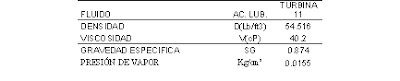
Las principales propiedades de los aceites lubricantes (turbina 11) bombeados se muestran a continuación:
FLUID
 IV. Operating conditions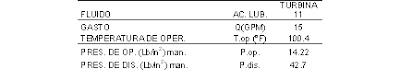
V. Design criteria.
The first step in our methodology is to establish the design criteria.
design criteria used for this system are based on national and international standards of design and installation of piping systems, which show the following:
The pressure drop per 100 ft of pipe (suction pumps supercooled liquid)
ΔP100 = 0.05 to 0.25 psi (lb/in2)
The recommended speed (suction of supercooled liquid pumps):
V = 1 to 5 ft / sec.

Fig. 2. Schematic diagram of the variables in a typical pumping system.
VI. Formulas
1 .- Diameter of suction: This will give an approximate diameter required but is not definitive because it must verify that it meets the criteria of the pressure drop
 2 - Reynolds Number
3 .- Friction factor: On this occasion we will use the following equation (Fanning), but this formula has limitations that will treated in the chapter on design of a phase line.
 4 - Pressure Drop per 100 ft pipe
5 .- Equivalent length (LE)
The following table gives the equivalent lengths of pipe for various accessories:
 Fig. 3. Table of equivalent length of valves and fittings in feet (API-RP-14E).
Click on this link to download fig.3 http://rapidshare.com/files/208835031/TABLA.jpg.html
6 .- frictional pressure drop:
 7 .- Load net suction available (NPSHd):

Where:
PS = Pres . abs e / suction cup (like our drum is open to the atmosphere will be equal to 14 . 7 PSIA = 33 . 93 ft of H2O) h = Height
liq. (With respect to the axis of the pump) = 1m + liquid height = 1.90 m = 6.23 ft
ΔPF = frictional pressure drop (ft)-is calculated
ΔP100 = pressure drop per 100 ft-(PSIG)
HV = Vapor pressure of liquid = 0.0155 Kg / cm ² = 0.22 PSIA = 0,508 ft of H2O
Re = Reynolds Number (dimensionless)
ρ = liquid density (lb/ft3)
Q = volumetric flow rate (GPM)
Di = Inner diameter (in)
μ = fluid viscosity (cp)
V = Velocity of fluid (ft / s)
For our particular case, the suction head as shown in Figure 1 The oil tank is above the pump shaft, so our hours will be positive (+).
VII. Calculations
1 .-
 As use the next higher diameter:
 Dn = 2 in
Di = 1,939
 2 .- 3 .-
  4 .-
4 .- 
How can we check our selected diameter (2 in), according the required flow (20 GPM), does not meet the criterion of pressure drop per 100 ft, although in speed if.
At this point one must consider the criteria of speed vs. pressure drop, usually suction pumps the most important criterion to meet is ΔP100, so proceed to select a larger diameter.
Dn = 3 in
Di = 3,068
recalculated are:
Re = 335,493 F = 0.1058 = 0,103 PSI
ΔP100
As you can see with a diameter of 3 in. in diameter, we have that if we comply with the pressure drop criteria set out in section IV. 5 .-
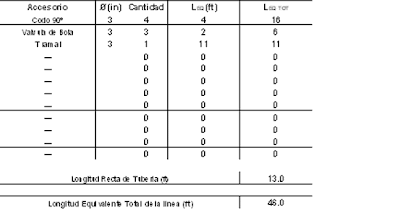
accessories including suction of these pumps is shown in the following table:
 6 .- 7 .-

calculated according to NPSHd NPSHR should check provided by the manufacturer, if the NPSH available is greater than the latter should be increased, otherwise it will form the phenomenon of cavitation in the pump.
IX. Application of thermodynamic properties:
The application in this example is the vapor pressure or saturation pressure, because if was not given due importance, and not taken into account, we may fall into the error that suction pressure is less than the vapor pressure, and thus be formed cavitation.
second application (CONTROL VALVE)
control valves are exposed to all kinds of influences in process control. This requires the existence of a large variety of designs depending on series and of what the specific problem to be solved in each particular application. So if we add to this variation may experience both physical and chemical parameters of the fluid, or all those parameters that can affect the process itself requires us to use a special calculation technique when performing the choice of control valve.
The phenomenon of cavitation occurs when a liquid flowing through a pipeline will reduce the flow through a control valve, it speeds up considerably (the principle of conservation of mass). This increase in speed leads to pressure loss (principle of conservation of energy). If this low pressure drop below the saturation pressure of the fluid, it produces bubbles of steam seeking greater pressure zones which collapse abruptly. These areas are often the control valve itself and immediately afterwards, since the pressure is recovered by slowing the rate to its initial value.

Fig. 4. Graph of pressure and velocity relative to the saturation pressure.
In this process, vapor bubbles form a static cavitation zone which varies in length depending on differential pressure. The vapor bubble implosions produce what is known as micro-jets (small portions of fluid propelled at high speed and short life, maximum number of milliseconds), them when they hit a solid material, such as a valve body, damage and wear. They may even eventually get "to eat" the body of the valve, especially in control valves that redirect the fluid. However, although they develop a control valve ingenious design, it would be possible for procedural reasons, to ensure that cavitation would be free of all conditions (for example Xf> Z)
 Fig.5. Areas of cavitation in a control valve.
 VALUE Z

Xf If the value is greater than the Z value, the valve will cavitate, as much as 0.802> 0.6 in our case there CAVITATION, and the greater the difference between value and value Xf Z Most get
cavitation Once developed the example above, we see the importance of awareness of the value Z of a control valve for a process to determine if the control valve to cavitate and magnitude.
far we have come to the application of thermodynamic properties, I hope you have been to your liking and give them a broader approach to these properties within the oil and gas industry. As you can tell clearly having this knowledge allows us to design effective and safe.
I hope in my next post, where interesting topics try Bá Engineering and music of detail ( Process, Piping usage coming from designers as , Instrumentació n and Process Control, Industrial Safety ) with a approach to the industry with more boom in Mexico, "the oil industry .
Until next time.


